
As a dangerous summer heat wave pushes electricity demand toward record levels, some of the nation’s largest data center markets are clustered in places where power grids are already under strain or facing warnings of future stress.
The pressure is most immediate in the Mid-Atlantic grid operated by PJM Interconnection, where recent federal emergency orders gave grid operators authority to call on backup generation and, as a last resort, curtail large users such as data centers with backup power. In Texas and Illinois, the picture is less immediate but still significant: grid officials say they expect to manage near-term demand, while regulators, reliability monitors and consumer advocates have pointed to fast-growing data-center loads as a source of future grid and cost pressure.
Mid-Atlantic
Perhaps the clearest example is the PJM region, which serves all or parts of 13 states and Washington, D.C., including Virginia, Pennsylvania, Maryland, New Jersey, Delaware, Ohio, Kentucky and West Virginia. PJM said this week it had issued hot-weather, maximum-generation and load-management alerts as extreme heat pushed forecast demand close to—and potentially above—its all-time summer peak.


On June 30, PJM forecast a July 2 peak of 166,304 megawatts, above its existing all-time summer hourly integrated peak of 165,563 MW, set in 2006. The next day, PJM revised the July 2 forecast slightly lower, to 166,147 MW, still high enough to potentially exceed that 2006 mark.
Data centers are not incidental to the PJM story. In an emergency order, the Department of Energy (DOE) cited North American Electric Reliability Corporation findings that PJM demand is growing at its fastest pace in years, “driven primarily by data centers,” followed by electrification and manufacturing loads. The same order said PJM faces tightening capacity because of generator retirements and project delays, raising the risk that emergency procedures may be needed during peak periods.
PJM said the DOE order allows transmission owners, if needed as a last resort before voltage reductions or load shedding, to curtail data centers and other large loads that have backup generation. That makes the Mid-Atlantic perhaps the strongest current example of a grid operator and federal officials directly linking heat-wave reliability measures with data-center demand.
Northern Virginia remains central to that dynamic. The Energy Information Administration (EIA) has described Northern Virginia as having the highest concentration of data centers in the world, while global commercial real estate services firm Cushman & Wakefield said Virginia remains the world’s largest data-center market by operational capacity, at 11.3 gigawatts.
A recently launched map by environmental activist Erin Brockovich shows data centers spread widely across the region, with especially dense clusters around Northern Virginia, the Baltimore-Washington corridor, Pennsylvania, New Jersey and Ohio.

The Bulletin
Want the morning news straight to your inbox?Sign upSign up to Breaking News alerts
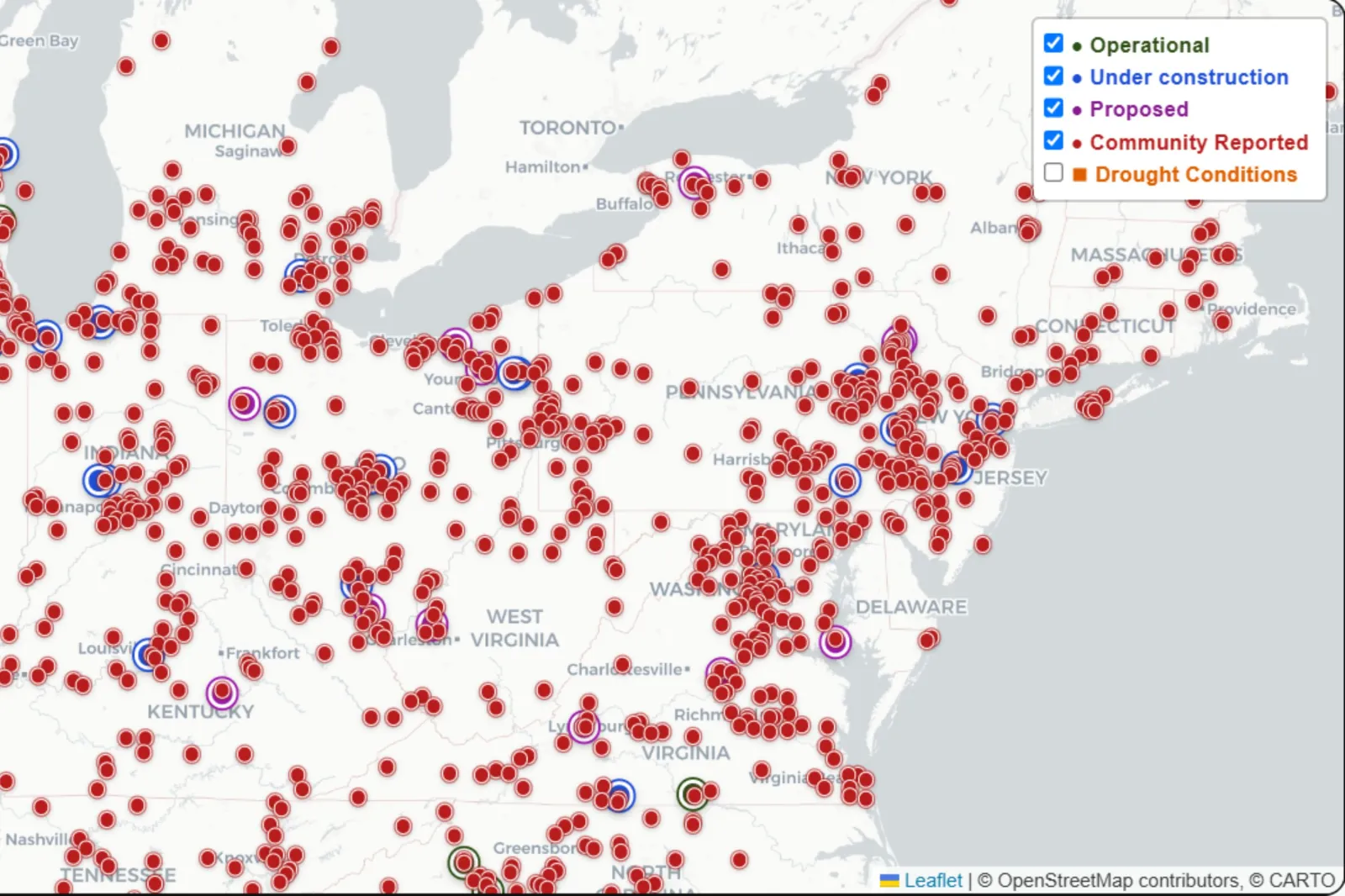
A map from brockovichdatacenter.com highlighting data centers across the region. | brockovichdatacenter.com
Texas
Texas presents a different kind of warning: less immediate emergency, more rapid growth. ERCOT, which operates the grid for most of Texas, said ahead of summer that demand could surpass 92 gigawatts, above the state’s current record of 85.5 GW set during an August 2023 heat wave, as reported by Community Impact. The grid operator attributed the expected increase in part to high temperatures and the growth of data centers and other large projects.
ERCOT officials have also said a grid emergency or blackout was unlikely this summer, citing new generating capacity. Still, the scale of expected large-load growth has drawn attention from federal and state energy observers. EIA projected that electricity demand within ERCOT would rise by seven percent in 2025 and 14 percent in 2026 as large data centers and cryptocurrency mining facilities come online.
Longer-term forecasts show even sharper potential growth, though with uncertainty. ERCOT’s preliminary long-term load forecast includes large industrial, crypto and data-center projects, and outside coverage has noted that ERCOT itself raised concerns about relying on preliminary figures for reliability analysis.

ERCOT says data centers, cryptocurrency miners and large industrial customers are requesting to build in Texas in growing numbers, with some exploring co-location arrangements that let them draw power directly from nearby generators. Those arrangements concerned Texas lawmakers, ERCOT said, because generation used by a co-located large customer is “effectively removed from the pool of resources available to serve all Texans.”
An ERCOT spokesperson told Newsweek: “ERCOT continuously monitors load growth and works closely with utilities, generators, and other stakeholders to ensure the grid can reliably serve demand. This includes advancing transmission planning, implementing the Batch Zero process for large load interconnections, and coordinating with the Public Utility Commission of Texas on long-term grid needs.”
Texas is also becoming a larger data-center market in its own right. Cushman & Wakefield ranked Dallas as the world’s No. 1 primary data-center market in 2026, while saying Virginia still had the largest operational capacity.
According to the Brockovich Data Center Reporting map, Texas is heavily populated with data-center markers, with the densest cluster around Dallas-Fort Worth and additional concentrations along the Austin-San Antonio corridor, around Houston and across parts of West Texas. Markers are spread across much of the state rather than confined to a single metro area, underscoring that data-center development is extending beyond Texas’ traditional urban hubs.
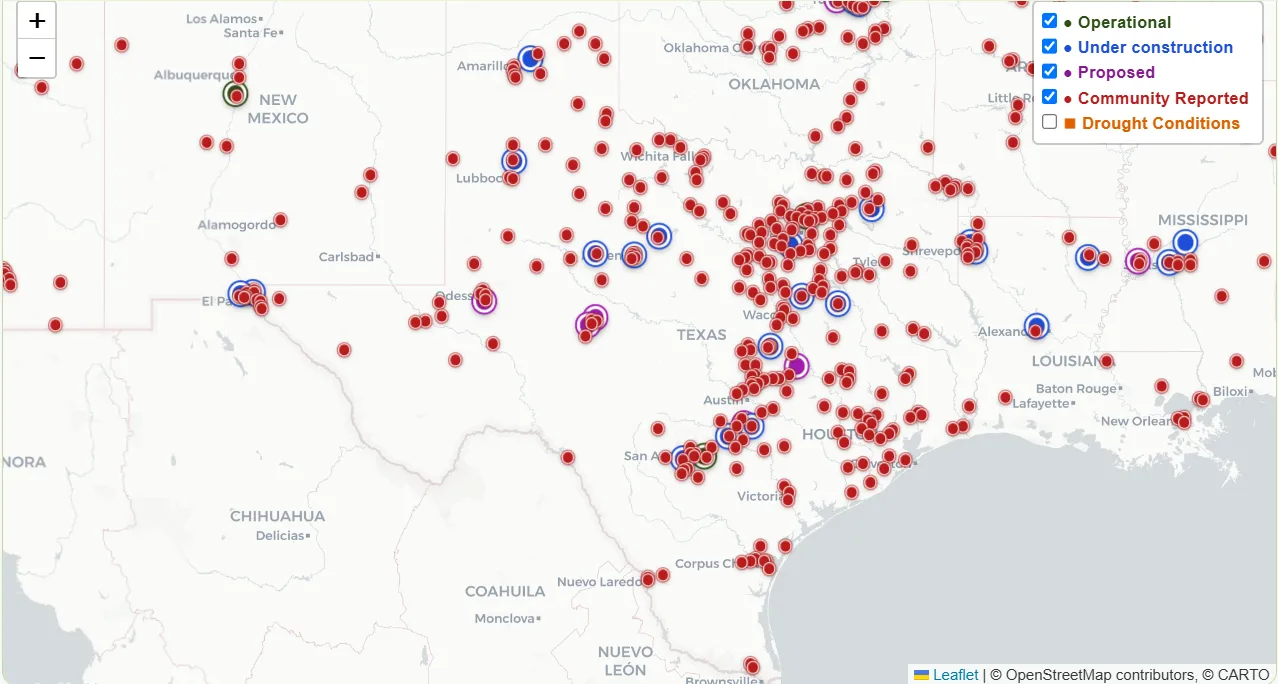
A map from brockovichdatacenter.com highlighting data centers across Texas. | brockovichdatacenter.com
Chicago
In the Chicago area, the immediate strain was local. On July 1, local utility company ComEd warned customers in parts of Chicago’s West Side and several west and southwest suburbs that the local grid was under “critical strain” or had reached a “critical level” during a heat wave, CBS News reported.
The warning covered areas including Berwyn, Cicero, North Riverside, Riverside, Stickney, Forest Park, Maywood, Oak Park and Chicago neighborhoods such as Little Village, North Lawndale, Douglas Park, Garfield Park and Austin. ComEd urged users to reduce electricity use to help prevent outages while crews worked on impacted equipment.
In Illinois, market analysts have suggested that data center growth could put pressure on the system. Commercial real estate services and investment firm CBRE said data-center projects served by ComEd face power-delivery delays until 2032 or later, and that new development is moving outside the Chicago suburbs toward larger power sites.
Illinois regulators are already examining how to shield customers from data-center-related costs. The Illinois Commerce Commission said ComEd has 75 large-demand customer applications in its pipeline, totaling more demand than the utility’s all-time system peak, and warned that such projects can affect other customers’ bills and ComEd’s ability to serve customers affordably. Separately, the Union of Concerned Scientists estimated that data-center load growth could add $24 billion to $37 billion in Illinois electricity system costs between 2026 and 2050.