
Secure AI Infrastructure refers to the hardware, software, and networking framework designed to securely develop, train, and deploy artificial intelligence models. It implements a “secure by design” approach, ensuring data protection, model integrity, and resilience against unique threats like data poisoning and prompt injection across the entire AI lifecycle.
A robust secure AI infrastructure integrates multiple protective layers to safeguard complex processing fabrics, model workflows, and the underlying data:
1. The Core Technological Stack

- Accelerated Compute: Purpose-built processing environments—using GPUs, TPUs, and specialized accelerators—housed within protected, isolated enclaves.
- High-Speed Networking & Storage: Low-latency interconnects (like InfiniBand or specialized Ethernet) designed to handle parallel processing loads, supported by secure storage systems (e.g., encrypted object storage and distributed file systems).
- Orchestration & MLOps: Container orchestration and machine learning operation platforms (e.g., Kubernetes) with strict workload isolation and security scanning built directly into CI/CD pipelines.
2. Key Security Layers & Controls
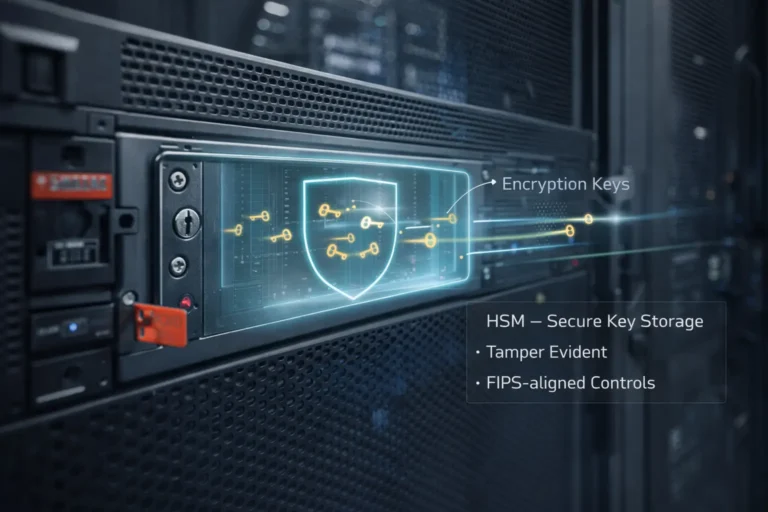
- Data Pipeline Security: Mechanisms to govern ingestion, cleaning, and storage. It emphasizes data classification, encryption (both in-transit and at-rest), and secure key management to prevent data breaches and leakage during training.
- Model & Runtime Security: Defenses applied to model artifacts and running systems to prevent adversarial attacks, such as data poisoning, model inversion, prompt injections, and jailbreaks.
- Identity & Access Management (IAM): Zero-trust architectures enforcing strict, fine-grained access policies. This ensures only authenticated and authorized users, automated processes, or AI agents can access compute clusters, datasets, and APIs.
3. Advanced Privacy-Preserving Techniques

To allow collaborative analysis or training without exposing raw, sensitive datasets, the infrastructure often leverages advanced technologies:
- Federated Learning: Training algorithms across decentralized devices or servers holding local data samples, without exchanging them.
- Differential Privacy: Injecting statistical noise into data or model outputs to prevent the reconstruction of individual inputs.
- Homomorphic Encryption: Allowing computations directly on encrypted data without ever unlocking it.
4. Governance, Compliance, & Monitoring
- AI Security Posture Management (AI-SPM): Continuous visibility tools that track models, monitor system behavior for anomalies, and ensure alignment with AI and data privacy regulations (e.g., GDPR, EU AI Act).
- Incident Response: Purpose-built, AI-tailored incident response plans that specifically address drifts in model behavior, malicious inputs, and operational disruptions.

Organizations establish this infrastructure to harness the full power of machine learning and generative AI while mitigating technical, operational, and reputational risks. To explore how tech leaders approach this, you can review Google’s Secure AI Framework (SAIF) or the NVIDIA AI Infrastructure Glossary.
Pinning down what AI means is harder than it sounds. Ask ten IT professionals and you’ll get ten different answers. It can mean chatbots, foundation models, ML pipelines, algorithms, infrastructure, depending on who you ask. They are all correct.
AI, as an academic discipline, has been around since the 1960s. At its core, it is computing that simulates aspects of intelligent behavior. Today, as AI matures and intersects with cloud and DevOps, it is evolving from a scientific field into an industrial domain.
AI operating models
Security teams must understand how AI actually shows up in their organization. The next sections break down what these systems look like, how they are built, and why they are adopted in different ways.
The AI value stack
A useful way to think about this is the makers, shapers, and takers framework often used by firms such as McKinsey when discussing generative AI.
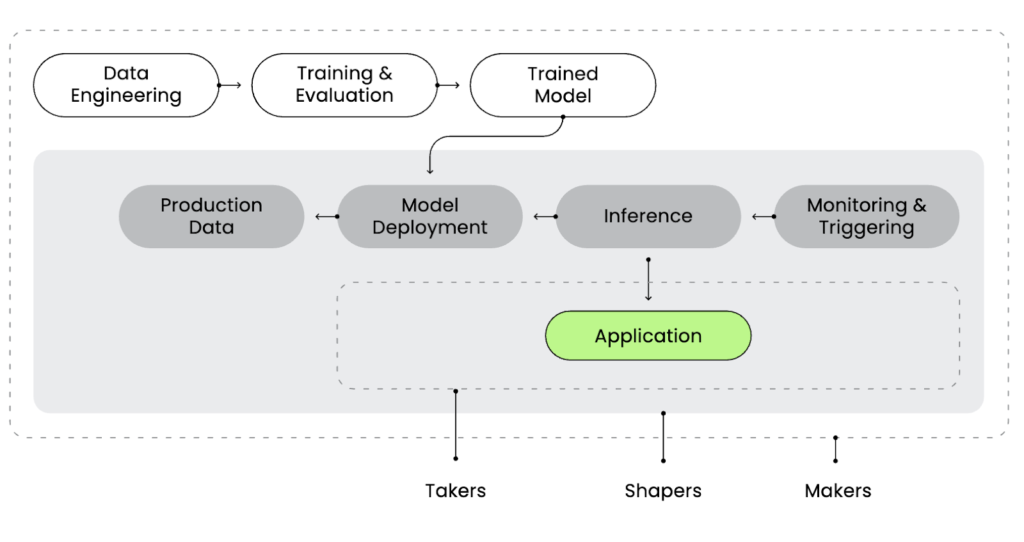
Makers are a relatively small group of frontier model vendors, cloud providers, startups, and research institutions that train foundation models using massive GPU capacity and vast amounts of data.
Takers include organizations and individuals consuming AI capabilities directly through platforms such as ChatGPT, Gemini, or Copilot.
Between them sits a broad ecosystem of shapers: companies building products on top of AI systems and adapting models through fine tuning, retrieval layers, or proprietary data integration.
For a more operational perspective, the AI Security Scoping Matrix from Amazon Web Services separates AI systems into five distinct responsibility domains. It is a useful reference when thinking about security responsibilities.

The architecture puzzle
As mentioned earlier, AI is a broad discipline. Below, we’ll review some basic distinctions and their risk profiles. This is only a high-level overview. For a deeper discussion, see the related blog series.
