
Government endorsement for two Sydney sites gives the manager the option to develop them into data centre assets
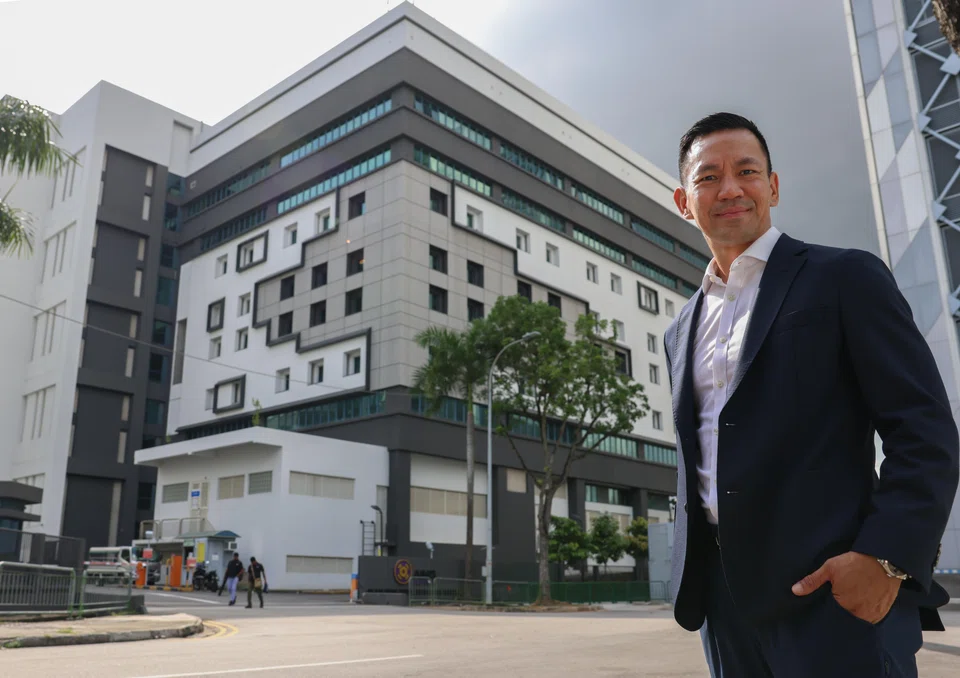
- Russell Ng, CEO of Aims Apac Reit’s manager, says that even after “another year of steady growth” in FY2026, the Reit is “making a deliberate pivot towards data centres”. PHOTO: TAY CHU YI, BT
[SINGAPORE] Mainboard-listed Aims Apac Real Estate Investment Trust ( AA Reit : O5RU +0.61%) is zooming in on data centre opportunities as it looks beyond traditional industrial assets for its next phase of growth, to tap rising demand for digital infrastructure.
“Even though we had another year of steady growth, we are making a deliberate pivot towards data centres,” said Russell Ng, CEO of AA Reit’s manager.
He pointed to two sites in New South Wales, Australia, that received government endorsement as potential data centre developments – a “significant game changer”.
The state’s Investment Delivery Authority in March endorsed AA Reit’s two Sydney assets at Macquarie Park and Bella Vista, among a select group of strategic data centre projects.
Ng noted that about A$92 billion (S$83.9 billion) in proposed projects were assessed, with around A$52 billion across 15 developments endorsed.
These included sites owned by hyperscalers such as Microsoft, NextDC, Stockland and Goodman Group.
Asean Intelligence
The endorsement, he added, helps to connect the assets to key government agencies, including those involved in planning approvals and energy coordination.
He also described it as “a big positive” that gives the manager “future optionality” to develop the sites as data centre assets, highlighting that data centre development is a multi-year undertaking.
In the light of this, Ng expects that substantial future development upside may come from Australia.
“If we are able to secure power and obtain the necessary approvals (from) the government over time, both these (Sydney) properties have substantial upside in terms of what they bring to the overall portfolio,” he said.
Singapore, meanwhile, continues to form AA Reit’s core leasing and income base.
Most of its leasing activity takes place in Singapore, where the manager has also undertaken the majority of its asset enhancement and redevelopment works.
“Most of our organic growth has taken place predominantly in Singapore,” Ng noted, adding that it has completed nearly seven asset enhancement initiatives, including six projects in the city-state and one in Australia.
It has also executed five redevelopment projects, again largely concentrated in Singapore.
Nevertheless, AA Reit’s Australian properties – which comprise three primarily master-leased assets with lease terms ranging from five to seven years – provide long-duration income stability.
These assets help anchor the portfolio, while the Singapore properties offer mark-to-market opportunities, lease renewals and asset enhancement initiatives.
Active manager
What differentiates AA Reit from its peers is its “active manager” approach, said Ng.
“We don’t just collect rent,” he said. “We constantly seek ways to manufacture income and capital growth through asset enhancements and redevelopments.”
In total, the Reit has about S$2.3 billion in assets across logistics, industrial business parks and high-tech properties, with roughly three-quarters of its portfolio in Singapore and the rest in Australia.
AA Reit is sponsored by Aims Financial Group, a Sydney-based fund manager and owner of the Sydney Stock Exchange, with a portfolio value of close to A$3 billion.
Ng joined AA Reit in 2020 as head of investor relations, investments and partnerships, then became chief executive in 2021. Prior to that, he was head of funds for Asia at Lendlease and earlier held roles in fund management at AEP Investment Management.
A key focus of his has been executing four strategic pillars – selective acquisitions, active asset management, prudent capital management and strategic partnerships – to achieve results.
He noted that AA Reit has delivered consistent year-on-year growth in revenue, net property income, distributions and distribution per unit (DPU) over the past five years.
The exception was the 2024 financial year, when equity fundraising of S$100 million temporarily affected metrics.
Earlier in May, the Reit posted a 4.1 per cent higher DPU for its second half ended Mar 31. It stood at S$0.0513, from S$0.0493 the year before.
Revenue for the six months increased 4.1 per cent to S$97 million, from S$93.1 million in the corresponding year-ago period.
The growth was driven by higher rental income and recoveries from logistics, warehouse and industrial properties such as 27 Penjuru Lane, as well as 8 and 10 Pandan Crescent.
The manager also cited higher income contributions from 7 Clementi Loop following the completion of asset enhancement initiatives.
“Investors were generally quite pleased at the fact that we’ve been able to, for five years in a row, deliver that top line… growth and almost year-on-year growth in DPU,” Ng said.
Investors’ main concerns centred on potential risks, including inflation, geopolitical tensions in the Middle East and interest rate uncertainty.
“Our feedback was that there was minimal impact on our portfolio at this stage,” he said. “Most of our energy contracts have been locked in and secured for the next two (to) three years.”