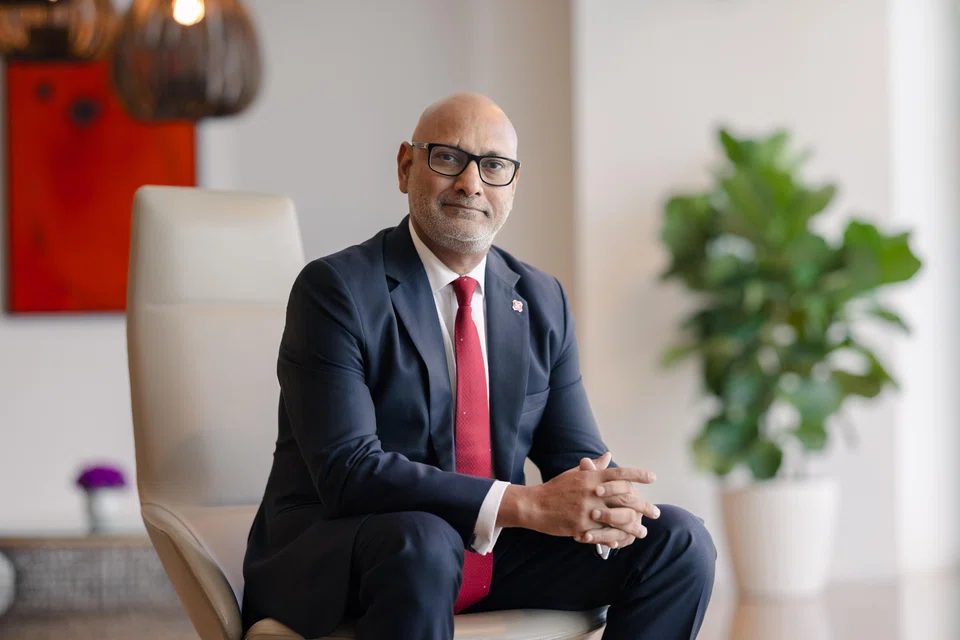
- Amit Sinha, global head of telecommunications, media and technology at DBS, says the lender is working to introduce US-style capital-recycling frameworks in Asia. PHOTO: DBS
[SINGAPORE] DBS : D05 +0.31% arranged more than S$20 billion in data centre financing across the Asia-Pacific in 2025, as an unprecedented surge in demand for artificial intelligence infrastructure – from data centres to semiconductors – begins to test the limits of traditional bank funding capacity.
Amit Sinha, global head of telecommunications, media and technology at DBS, estimates that the total capital expenditure of key data centre hyperscalers – such as Google and Microsoft – and their suppliers could reach US$1 trillion in 2026.
The worldwide AI boom has driven up these players’ capex by 70 to 80 per cent year on year, he noted.
With this growth showing no signs of slowing, he expects data centre capex to climb to between US$4 trillion and US$7 trillion by 2030, from the US$375 billion recorded in 2025.
But as hyperscalers seek funds to support their ambitious growth targets, banks are adapting how they finance such projects.
To manage exposure, lenders are increasingly co-financing or syndicating large deals. In 2025, DBS and UOB jointly provided a 6.7 trillion rupiah (S$530 million) loan facility for a data centre campus in Batam.
Asean Intelligence
Get insights into businesses across South-east AsiaGet the free report
Others such as OCBC and Standard Chartered have also been active in financing data centre developments across Asia in recent years.
However, Sinha warned that if infrastructure spending continues to grow at current rates or even more quickly, lenders risk hitting single-borrower limits and eventually running out of balance-sheet capacity.
To work around such constraints in the US, hyperscaler developers are increasingly turning to more mature financing structures to recycle their capital.
These include asset-backed securities (ABS), commercial mortgage-backed securities (CMBS) and, more recently, the rated bond market. ABS are bonds backed by non-mortgage loans, while CMBS is a subset of ABS supported solely by commercial property mortgages.
While such structures are well-established in the US, they remain largely absent in Asia, Sinha said.
Instead, the region has leaned heavily on the real estate investment trust (Reit) model to fund data centre assets. But these typically invest only in completed, income-generating assets, limiting their role to later stages of a project’s life cycle.
The Singapore Exchange currently has three data centre Reit listings – Keppel DC Reit : AJBU +0.9%, NTT DC Reit : NTDU +1.06% and Digital Core Reit : DCRU -1%.
Sinha said that DBS is working to introduce US-style capital-recycling frameworks in Asia to fill what he described as the missing “middle part” in the funding ecosystem.
He expects such structures to emerge first in private markets, with a small group of investors, before gradually expanding into public markets.
At the same time, he cautioned that newer entrants into the data centre market are adopting more aggressive financing and lease structures, including shorter leasing periods and tighter contractual terms.
While shorter leases can support higher rents, they also increase operational and refinancing risks for both operators and lenders, with many of these players backed by private equity capital.
If alternative financing channels and debt-recycling models fail to materialise, Asia’s data centre buildout could slow, constraining the region’s broader digital infrastructure ambitions.
But despite these challenges, Sinha remains confident that the sector’s growth will continue, supported by strong underlying demand for AI infrastructure and a widening pool of capital beyond traditional bank lending.
“We just have to be very watchful, to make sure that we know where our parameters are,” he said.